STATE OF THE CITY AND BUDGET ADDRESS BY EXECTIVE MAYOR ZINTLE PETER AT THE COUNCIL MEETING ON 30TH MAY 2006.
Madam Speaker, I rise to present the 2006/2007 budget and to request your indulgence for the traditional State of the City Address.
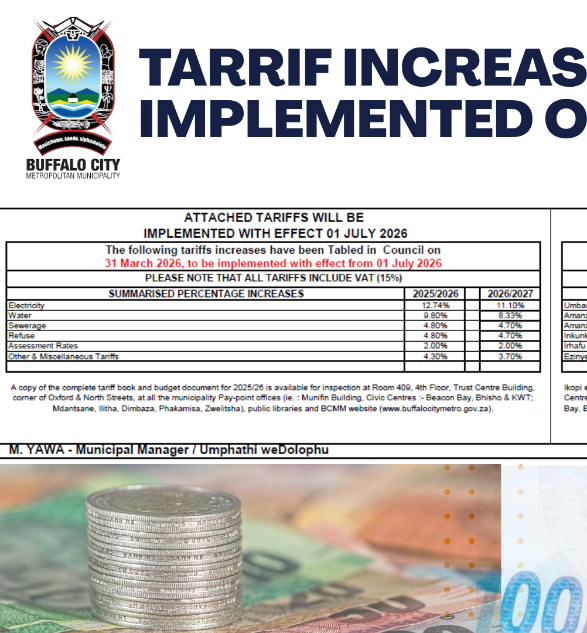
The 2006/2007 budget totals R2,1 billion and reflects an average 5,38% tariff rise. It contains an increased social wage in our endeavours to help the poor.
The theme of my address is:
Governing with Grace in an Age of Hope.
It is a theme based jointly on President Thabo Mbeki's assertion that we are living in an age of hope and my belief is that we must build on it by governing through the Grace of God.
In doing so, I commit to moulding an equitable society free of hunger, squalor, misery and injustices by placing my trust in Jesus Christ for wisdom and grace to lead this City with dignity for the next five years.
I will also rely on the collective wisdom of my African National Congress comrades as the vanguards of the People's Movement that deployed me here. It is they who must guide me on the complex road of reconstruction and development.
It is my hope that in the next five years others who purportedly subscribe to our commitment to undermine poverty and joblessness will find it in their hearts to support our democratic upliftment for the less fortunate.
About 55% of our nearly 800 000 people come from indigent households. This means each of these households has a combined income of less than R1 500 a month.
Some statistics record households as having no income, locking them in a brutal cycle of poverty. They exist in pockets of unspeakable human horror around the City such as in Duncan Village's C section and Second Creek. These areas are less than five kilometers from where we gather today.
In the quest for democratic and accountable governance that ensures sustainable service delivery and promotes socio-economic development in a safe and healthy environment, we must focus our united efforts on these people. Not on divisive non-issues.
Voters expect us to work together in their interests to stem the rise of joblessness as it heads toward the 40% mark. Research tells us that we need to create 7 340 jobs annually to halve joblessness by 2014. Poverty levels are deepening
Creating jobs is not sufficient if we do not insist on skilling and training. Workers must be able to function in a knowledge economy.
I am pleased that the municipality has an agreement for a learnership programme with the Department of Public Works in terms of Extended Public Works Programme to train 10 contractor teams. The City has committed to the EPWP via three capital programmes of R65 million for projects that support the programme.
On unity, we must understand that voters know that from time to time there will be differences which generate more heat than light. There is no reason why we cannot make the multi-party committee work.
I have appointed Councillor Andile Ntoni to head the key public participation, constituency and communication portfolio because I want a crusade launched for people-centered governance.
I believe democracy is not only about how representatives are chosen. It is about how ordinary citizens are regarded in the decision-making process.
They MUST be co-governors and not passive onlookers and they must be equal to decision-makers. We have used our successful IDP hearings as an enabler in this regard.
Councilors must be the custodians of all critical information on economic activities, unemployment and poverty in the wards and ensure that those who qualify are in the social security safety net.
Such work is the most tangible form of public service together with vibrant well functioning Ward Committees that will inform the IDP and Local Economic Development (LED) strategies.
I will come back to this issue later because I want a communication culture entrenched for continuous dialogue and reflection, not just knee-jerk reactions with unsustainable advice on how to run the City.
I have started to drill down information to all by establishing sectoral dialogical forums. If you look on our website (www.buffalocity.gov.za) you will find this speech on a sub-site.
Madam Speaker, I want to take this opportunity to make a public apology to those of our people who feel their constitutional rights are being violated or who feel they are suffering civic abuse because of poor services.
To the more than 30% of our people who still suffer the indignity of unacceptable sanitation, who do not enjoy clean piped water and a reliable electricity supply, whose refuse is piling up on unkempt dirty potholed streets, I say sorry.
I say sorry to the 200 people who use one public toilet in Duncan Village's C section.
I say sorry to mourners who cannot get to the deceased's Mdantsane home because of impassable untarred roads flooded by a non-existent storm water drainage system, or those who bury their loved ones in an undignified manner in unkempt cemeteries.
I say sorry because this is not the better life we aspired to and because I come from a caring political culture that is just and equitable and seeks peace and harmony in an environmentally sustainable clean City that we can all call home.
I ask that you judge me on what I do about it.
Interventions are underway. A socio-economic profile is being undertaken to find a sustained and just solution to the inhuman search for food on the rubbish dumps at Second Creek.
This is an established community with their own survival techniques and livelihoods and it needed a strategic intervention with sensitive social facilitation to rehabilitate and relocate them. You don't just disestablish a community apartheid-style with a bulldozer and dump them elsewhere.
Measures to deal with rubbish on the streets, electricity outages and the general sprucing up of the City are also underway.
Six new refuse trucks costing R7,3 million have been ordered and will be here in five months to bolster the ageing 52-vehicle fleet which has an estimated replacement value of R53 million.
Another three trucks are to be ordered but a vehicle replacement cycle must be looked at because we cannot afford to continue with an unsustainable practice that has compromised service delivery. A maintenance plan will be put in place and alternate forms of delivery investigated. Immediate steps are being taken to ease the situation in the interim.
Panels costing R4 million each have been ordered for three electricity sub-stations but can only be delivered in December. On time availability of such equipment and finance for forward buying must be considered. Efforts at reprioritization are underway to look at special irregular supply situations such as Gonubie and Mdantsane, among others.
The large-scale backlog in housing delivery (75 000 units) together with services and the R1,4 billion deferred maintenance to ageing infrastructure have all impacted negatively.
Water and electrical reticulation as well as sewage disposal, road maintenance and tarring have all contributed to compromised delivery.
Excessive water losses reported by the Auditor-General have been cut from 45% to 38% and a water and sanitation management system is due for completion this year.
A total of 5 500 water meters have been installed in previously unmetered areas and according to research, our treatment infrastructure needs to be extended from 187,8 mega litres/day to 200,5 mega litres/day in line with the requirements for long-term planning of the City. A road, water and sanitation management system are due for completion later this year.
The fight against electricity loss which costs the municipality hundreds of thousands of rands annually through tampering and illegal connections continues.
In terms of infrastructure development, Expressions of Interest have recently been called for the upgrading and expansion of the city's water and sanitation networks. The value of this project will be in excess of R2 billion and will secure the city's water and sanitation provision for the next 15 years.
I would like to point out, however, that a study into the state of South Africa's infrastructure calls for as much priority to be given to the maintenance and refurbishment of existing infrastructure as is currently being paid to the development of new energy, transport, telecoms and water projects under the R372-billion Accelerated and Shared Growth Initiative (Asgisa), the programme we have to ensure that we interact with creatively.
The Development Bank of Southern Africa (DBSA) warns that the sustainability of existing as well as new infrastructure would be placed in peril, unless urgent attention was given to life-cycle maintenance. It argued further that the mere provision of infrastructure would "never be a sufficient" condition for growth and development and that effective infrastructure investment would depend materially on the development of strong and appropriately-skilled institutions, effective regulation, long-term, economy-aligned planning, and the efficient use of infrastructure.
Back on the local front, funding has been set aside for the development of the Quinera area. There is an amount of R30 million for the next financial year but I must hasten to add that I am sensitive to the oversight role of balance between social and economic investment.
A Quenera Local Spatial Development Framework had been initiated last year as a result of growing demands from the property development sector to change land use and develop a range of commercial, residential and industrial premises between the Quenera and the Gonubie River.
Projects overall to the value of R168 million are currently underway while a further R115 million are still in the design stage to be implemented within the next 12 months.
I will talk later about our heated property development market and our attempts to balance investment for job creation and social investment that results in some forms of a better life for our people, especially the poor.
On our roads, a traffic management and safety programme is underway. Unfortunately, you may have read in a weekend newspaper report how we beat Nelson Mandela Metropole hands down when it comes to drunken driving.
I don't want to talk about the zero tolerance cliché suffice to say our traffic officers are up to the task.
New pedestrian facilities have been provided along the Ziphunzana Bypass because of heavy traffic.
A new traffic circle has been constructed at the Pearce/Suffolk intersection and work has commenced to provide traffic circles at the Botha/Gately and John Ballie/McJannet intersections.
Speed humps have been provided at various schools around the city. Recently we embarked on a R28 million project to provide traffic safety infrastructure at all the schools in Mdantsane and I want traffic calming efforts to spread to the formerly marginalized areas, especially the main road through Scenery Park where death stalks.
A programme to renew guidance signage in the city was embarked on some time back and the guidance signs along the M1 route (Oxford Street) has been renewed, news that will hearten the leisure industry and Buffalo City Tourism which is being revamped to possibly become a municipal entity.
All the traffic signals in King William's Town were upgraded to comply with legal requirements. The Area Traffic Signal Control system was upgraded to use GPRS technology which will result in substantial savings in operating costs.
On public transport, taxi embayments have been constructed in Woolwash Road and Union Avenue. The upgrade to the taxi rank in Mdantsane was completed this year and the rank at Dimbaza will be upgraded during 2006/7.
It is hoped the taxi recapitalization programme will succeed and cascade to local level so that we can settle disturbances which arise occasionally in this crucial sector of our economy.
The municipal bus service continues to be targeted at scholars and over the last three years, almost half the fleet of 33 buses has been given a face lift.
Additional buses have been introduced during 2005/6 on the heavy demand routes to reduce overloading.
The provision of a new integrated public transport service is being investigated which will extend scheduled services to Mdantsane and be integrated with an improved railway service and pedestrian facilities linking into new public transport interchanges.
I am discussing complaints about some unserviced bus routes.
All in all we have a R476,9 million capital budget to be spent on water (R33,5m), waste water (R36,7m). electricity (R29,8m), roads and stormwater (R40,3m), housing (R150m), transport planning (R80m), cleansing (R11,6m), amenities (R28,7m), environmental services (R2,6m), health services (R5,5m), public safety (R20,5m), support services (R34m) and other (R1,9m).
I am listing the details of this budget because I believe councilors need to be reminded that budgets are redistributive tools that must correct the imbalances of the past and bring former marginalized areas onto the development agenda.
We cannot be seen to be entrenching and perpetuating the spending patterns of the past and I note with pleasure in the budget that other areas have been included like the Duncan Village Redevelopment Initiative, Mdantsane Buffer Strip and a host of areas that need serious social infrastructure interventions.
I am being assured that three pilot sites for medium density housing are to start soon and that Duncan Village will have to be de-densified with some of the 20 000 existing households having to move to Reeston. The shack count in Duncan Village has revealed 70 000 so far.
Only 4 000 single 35 to 45 sq meter units can be built in Duncan Village and it will not be able to accommodate the 20 000 households listed. A total of 800 units in Reeston C have been approved for Duncan Village beneficiaries.
Buffalo City is one of the first municipalities in the Eastern Cape to be in the accreditation programme and is in line for capacity funding for the next two financial years.
Settlement planning is underway and in Fynbos in East London, a feasibility study has been completed and approved. A comprehensive funding application/business plan has been submitted.
Council has bought land and approved the layout for 540 erven at Sunny South for housing and adjacent land is being investigated for the Paratyana and Shelford communities. This will add an additional 500 erven. Council has approved the layout of 1 400 erven for Needs Camp while funding approval was obtained from the Dept of Land Affairs for formalisation of 4 000 erven in Yellowwoods. This project is currently underway.
Other settlements approved are Bongweni (Phakamisa/Clifton PH 2), 500 erven; KwaTshatshu 1308 erven; Ilitha North 164 erven; Ilitha North 13 erven; and Mdantsane Infill Areas 700 erven.
The upper market housing sector is enjoying the heat of the general property market and the municipality was pleased this month to note that royalty in this sector, Pam Golding Holdings, established a new headquarters in East London. Pam Golding did slightly over R12 billion turnover world wide in its operations in the last financial year and the East London franchise investment sends out a measure of confidence in the City.
Between July last year and April this year, 3 131 building plans were passed, not all houses of course, to the tune of R577 476 096.
The plans include the Amatola Shopping Mall in King William's Town (R18,988,000);Daimler Chrysler Bodyshop (R44 956 000); IDZ Automotive Supplier Park (R84 838 000) and the Ikhwezi Foxtech Warehouse in East London (R8 747 000)
Land sales have also been vigorous and includes a
City Lodge Hotel site for R1 368 000 and 65 erven in Vincent Heights, East London, for residential development. Tender awarded for the sites was R17 million. There was also the sale of 17 residential erven at Nahoon Mouth for R6 million.
An application has also been received from the Department of Public Works this month for a 40 000 square meter site in Bhisho for a R200 million office block for the Office of the Premier.
The financial injection into the area would most certainly be a major catalyst towards the revitalization of Bhisho.
I believe this is a welcome injection because we want a more balanced approach to the City's growth. It is no secret that while the East London node has seen tremendous growth in the industrial, commercial and residential markets, the same has not happened in the KWT/Bhisho area.
Rather, the area has witnessed major disinvestments especially from textile companies based in Dimbaza which has had a devastating effect on the communities living in these localities.
The strategy of public sector led investment in the KWT/Bhisho corridor will hopefully raise investor confidence and stimulate the return of the private sector.
The municipality is busy with a new R11,4 million
Public Safety Centre in Bhisho which hopefully will be the stimulus to reviving the development efforts of the region.
The positive benefits of downstream goods and services required by these two projects will set the tone for the revitalization of this area. I am adamant that King/Bhisho area must assume its rightful place as the Provincial capital.
A new era:
Madam Speaker, I pledge a new era.
It is an era in which we will return to the basics of developmental local government anchored in our Integrated Development Plan and which features a united long-term people-centered vision.
It is an era which will entail major industrial and commercial development of the City that will integrate small, medium and micro enterprises in a collective effort to create jobs and alleviate poverty.
The City's vision is linked to our Provincial Growth and Development Plan as well as our National Spatial Development Framework.
This is an era that will be driven vigorously by a revitalized and transformed corruption-free and responsive institution manned by both political and administrative development activists who add value to our City, value that can be measured through a simple good Performance Management System linked to our IDP and Budget.
I am committed to inculcating an institutional service delivery culture headed by a hard-working conscientious and committed implementation team that is respectful of the political leadership and sensitive to the desires and wishes of our people
I hope to have a City Manager appointed soon to bolster our strategic leadership and to push capital spending beyond the existing 46%.
I had a brief interaction last week in Cape Town with Minister Folisani Mufamadi and was heartened by his understanding and interest in Buffalo City.
My office is setting up a meeting with him to enable me to present fully the challenges the City faces. I intend asking him for additional expertise to assist us.
A meeting last week with Auditor Silinga Ngqwala also drew my attention to his constant reference to our much-needed Performance Management System.
A single unit is established to deal with both institutional and personnel performance management and I am certain that this key aspect of governance will not be found wanting in the future.
Madam Speaker, it is against this structured interventions and sophisticated analysis of our challenges that we are moving to overcome our challenges...
I will not entertain knee-jerk unsustainable short-term reactions as solutions. We must respond with sustainable budget-linked and IDP-ordained solutions that will make our people proud of their City.
It is in this way that our successful IDP processes led us to our communities' priorities. The IDP hearings told us communities want:
- more say in the IDP and Budget
- houses and land;
- community facilities and services;
- roads and transportation;
- economic renewal and jobs.
Six issues emerging from the consultation process informed the slicing up of our budget:
- Lack of a long-term development strategy that blurs our vision
- Sustainability threats caused by shrinking revenue in relation to costs
- Institutional inefficiencies that compromise delivery
- Growing Gini co-efficient, low economic growth and rising joblessness; and
- Lack of transport, social services and economic opportunities.
Madam Speaker, these exercises executed at 28 clustered meetings across the length and breadth of Buffalo City, have informed our budget.
As a result, I am proud to announce that they have guided us to the extent that I am returning soon to the communities armed with R20 million top sliced from the budget to ensure a targeted attack on priorities identified by communities.
In addition, all 45 Wards are to each receive R100 000 for special projects identified by the soon to be elected Ward Committees. It is these Ward Committees which are destined to entrench democracy as virtual decision-makers for this additional spend.
I believe this is the real start of ward-based community planning.
The BC development debate:
Comrades and Colleagues, I believe that if we want to sustain the economy, build our society, protect our environment, improve safety, eliminate poverty and create a climate for job creation we will have to confront the divisive national debates which boil down to social versus economic spending.
We have to indeed look whether we are investing in business-boosting infrastructure that makes the rich richer and neglecting social investment that makes the poor poorer.
The debate is as old as our democracy and I believe there must be a balanced approach based on trade offs with the final outcome being job creation, poverty alleviation and strengthening of the economy.
I believe in creating opportunities for people that will restore their dignity and not make them dependent on hand outs and grants.
I am pleased that we are giving 55 000 indigent households a subsidy on their accounts which will result in an increase in the total welfare package from R196,37 a month to R206.
Pensioners and the disabled are still getting 40% rates rebates while all indigent families are getting the 50kw/h free electricity and 6kl water a month.
We obviously would have liked to have done more to alleviate the rising poverty levels but our resource base is too narrow.
We need to secure additional grant funding and stake our claim in the R400 billion government is to spend on infrastructure over the next five years. As I have said, we must integrate innovatively with AsgiSA.
We need to be creative on the funds being made available to development opportunities such as the World Cup Soccer in 2010. We can still turn it into a development opportunity and I am going to make some appointments to drive the process.
Nevertheless, we are going to do the best we can with our capital budget for economic investment to keep us in the running as an investment destination.
We are going to see to it that we have investment-ready opportunities available and that we are in fifth gear development-wise to meet investment inquiries. We must be positioned for public-led investment that gives us a competitive edge on other cities.
It is with pride that I can announce today that next Monday, I will turn the first sod at the site of the R300 million Mdantsane shopping mall where some 900 jobs will be created and monumental revenues are expected to be generated as the City tastes its share of the fierce global retail competition.
Billion Group developer Mr Sisa Ngebulana is here today and he has confirmed that work on the environmental impact assessment for the R2 billion Gonubie golf resort is expected from the Department of Tourism and Environmental Affairs by June.
Comrades and colleagues, I think Mr Ngebulana's confidence-boosting investment deserves a round of applause.
The City has been the flavour of the first quarter of the year with mall developers beating a path and with one developer summing it up as follows:
"There is huge potential to be unlocked in Buffalo City," he was quoted in the media as saying.
Five different proposals had been received in February. We believe the market is speaking to the developers and we are seeing the natural progression from a residential property boom to a retail boom.
There is no doubt that a third wave will follow directed at the beachfront as a result of demands from the entertainment and leisure industry.
It bodes well for the Buffalo City Development Agency (BCDA) which had been established to transform the City's skyline, particularly the beachfront area in its first phase.
The BCDA business model and its current activities promise to be a vehicle that will carry job creation and set the tone for future development in the city.
The City has granted the BCDA permission to develop its first three pilot sites through the active participation and involvement of the private sector.
It is envisaged that the three pilot sites will change the face of the beachfront area and influence the development of the Quigney and CBD in a sustainable manner.
Ladies and gentlemen, there are great development prospects for the City.
Two main development partners are of course the University of Fort Hare with its decision to earmark East London as its growth node with its R100 million spend and the DaimlerChrysler multibillion investment and its keen interest in the City as the home of one of the best cars in the world.
Of course there are the transport links – the rail, harbour, airport and road network – which are all crucial to development, each with its own development processes unfolding as we gear up for the future and position the City as a multi-nodal complex.
I am mindful the role the City must play in our development. We need to develop long-term, strategic, city-level economic development perspectives that give certainty to all players and stakeholders. I pledge to do this.
I also accept the constraints that we will seldom be able to directly influence economic fundamentals such as labour market efficiency or key macro-economic policy choices.
However, we do have a key role in addressing micro-economic constraints on the economy in our ability to direct the nature and responsiveness of city services, prioritize city infrastructure and lead economic development partnerships.
We will do so to ensure a balanced economic framework that integrates our smaller enterprises into the whole as confirmation that they are the dynamos of any economy.
In pursuit of our role, we have adopted a City Development Strategy that has four pillars: good governance, financial sustainability, inclusivity and productivity.
These are the four goals we will pursue and we ask all stakeholders to join us in making Buffalo City a great place to live, work and play.
I thank you
ENDS.
Zintle Peter
EXECUTIVE MAYOR
30th May 2006.