

|
10 June 2004
2004/2005 Budget and State of the City Address
By Executive Mayor Sindisile Maclean.
Introduction
Madam Speaker, I rise for the presentation of the 2004/05 budget and seek your indulgence for my traditional State of the City Address. This public reflection on the State of the City, its financial fitness and our prospects to deliver on our socio-economic Constitutional mandate comes at a strategic moment in our history.
It is a moment in our unipolar world where power relations are skewed. Nations trample over nations and regime changes or attempts thereof are executed with impunity.
Globalisation hovers over our seemingly borderless global village, impacting on our political and socio-economic discourse from Pretoria to our own Potsdam.
Context
It is a discourse parametered by President Thabo Mbeki's State of the Nation address three weeks ago in which he boldly and analytically set the country on an exciting definitive time-fixed interventionist course to fight entrenched poverty, joblessness and inequality.
Let us have no delusions about the daunting, intractable and complex challenges we face as we present this R1,6-billion budget, our third poor-friendly budget which is formulated in a manner in which it does not overburden those who have the means.
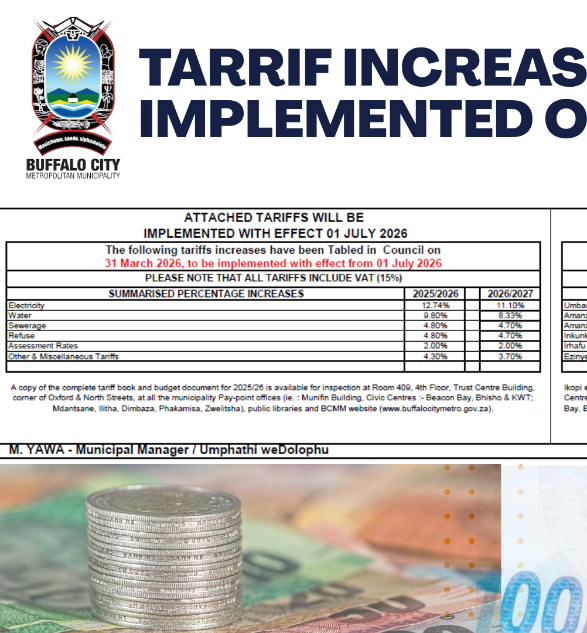
Neither is it business investment prohibitive nor does the 6,89% average rise in rates and tariffs to balance the budget run counter to the Reserve Bank's inflation targeting.
It is unashamedly a pro-poor redistributive budget used as a tool to address the stubborn legacy of apartheid.
It is formulated in terms of Section 152 of the Constitution which orders us to structure and manage administration to budget and plan so as to prioritise the needs of the community to promote social and economic development. This must be delivered according to identified Key Performance Indicators (KPIs). We fit this bill.
However, if the budget, as well as our strategic plans, is to be taken seriously, it must rest on available fiscal resources and institutional capabilities. Like the other 283 municipalities in the country, we wrestle with these fundamental problems.
In cushioning the harsh and deepening poverty among our people, we have used our R174,5-million Equitable Share (ES) to provide a R118.80 monthly social package to our 40 000 indigent families who have registered and proved that each family earns a combined monthly income of under R1 500. The R118.80 goes toward subsidising their services while our package for the poor also gives pensioners a 40% discount on their rates. The disabled are also catered for.
We urge people who qualify to apply annually. But we want to assure those who have the means to pay that they are not being overburdened. Unfortunately, nobody can escape the responsibility of reversing the grim legacy of apartheid neglect and marginalisation.
In providing this social safety net for the poor we are not promoting dependency. We are sensitive to what sociologists call the Theory of Bargained Liberalisation. The theory argues that through their budgets, governments increasingly turn to social grants as a way of compensating for their inability to create jobs.
The structural impediments to job creation and the mismatch of human resource capacity and the requirements of our knowledge-based economy are well documented. It is the reason why you read in the newspaper about a man living in an East London informal settlement for 15 years being unable to find work.
As part of the intervention in our people's poverty, we are successfully delivering on Free Basic Services (FBS) with six kilolitres water monthly to more than 194 290 households. The 50kw/h of free electricity has been reserved firstly for the 90 272 households classified as poor according to the figures used to calculate our Equitable Share.
But there are more and the subsidy has also been extended to cover the 12 500 poor families of the 36 400 on the Eskom grid.
I often meet people who question why they must pay for water, which falls freely from the heavens, and what 50kw/h of electricity a month can do for their families.
Cost recovery is, however, an integral part of having purified water on tap. The free six kilolitres cuts every household's cost by just under R20 a month. The 50kw/h free electricity, I am made to understand, is sufficient power to burn a 100 watt bulb for 1 439 hours or a two-plate stove on high for 47 hours.
We believe our people should learn to conserve consumption and everybody should become sensitive to the harmful effects to the environment of fossil fuel-based resources.
The City Manager and I led a contingent last November to the City Energy Strategies Conference in Cape Town where a consumption crisis in cities was identified and strategies to conserve municipal consumption were discussed.
Key officials need to interrogate those discussions to see how a simple strategy called retrofits can cut internal consumption. The target set was for all municipal energy operations to be cut by 20% by 2005. We must get out of silo thinking and operations and embrace the broader vision. We must move beyond traditional ways of doing things and become sensitive to the pollution and ecological harm fossil fuel-based resources are causing the environment.
Retrofits involve the use of energy saving devices which can cut your electricity bills dramatically. I remember the Minister of Mineral and Energy Affairs talking about saving something like R600 000 in a government building.
Despite our lifelines to the poor, 39 679 prepaid meters were blocked last month for non-payment through the Contour system, a computer programme which controls pre-paid electricity sales and combines this with credit control sanctions as well as free basic issues. Another approximately 2 000 on the old system.
I want our people to understand this because I believe that, especially in the taverns, in shebeens, people blame Sindisile Maclean for their families being in the dark when they cannot buy electricity.
It is not him. It is a computer programme that is sanctioned by law because Credit Control and mobilising people to pay comes with the legal mandate to govern. We have had to protect the institution by including a more than R60-million bad debt reserve.
We are legally bound to collect all outstanding municipal money and it is common knowledge that we had to invoke our Credit Control Policy even on government departments this year.
Cost recovery is key to running the City and our outstanding more than R372-million arrears remains a major stumbling block to our effectiveness and efficiency.
We are keenly watching the pilot project in which national government is trying to sell off R10-billion of municipal debt to the private sector. Simultaneously, we are trying innovative ways of collecting our outstanding money and promoting people to pay through our successful Pay & Win Campaign.
However, we have taken this budget to communities for interrogation at some 30 meetings and outlined the financial pressures under which the City operates. Our pressures have been understood and our strategies endorsed. If people feel now they have not had a say it is because they have shirked their civic responsibility and cancelled their right to co-govern.
The future of the municipality's R385,5-million electricity income is under threat. According to President Mbeki in his State of the Nation Address, Regional Electricity Distributors (REDs) will be ready to operate by June 2005 and the whole process for these new distribution structures will be completed by 2007. This will end municipal electricity sales as we know it.
Electricity is the largest of our total R1,1-billion income streams and we will have to strategise on how to deal with the REDs challenge.
Water charges at R138,8-million and assessment rates at R249-million are the other two main streams. The rest of the income is refuse charges (R82-million) sewerage (R94,8-million) and trade effluent (R4,49-million) with the other totalling R146,1-million.
Income from both water and rates also face challenges: we are losing millions of rands on what engineers refer to as Unaccounted For Water (UFW). The international norm for UFW is 15% but our loss is more than double the norm. Work is being done to stem the loss.
The new Property Rates Bill, which will make rates uniform throughout the country, is expected to be signed into law next month.
The Bill has caused tremors in some areas with critics alleging it is a "wealth tax". The Act gives us four years to phase it in during which time we will formulate our policy.
We commissioned an international expert to review our rating and tariff policies. It has already been found that we have complex issues to address if we are to comply with the Act. The quest for a new financial model is still underway.
The budget we are presenting has thus been formulated under tremendous pressure.
Challenges include:
- HIV/Aids, with 16% of pregnant women in Buffalo City registering positive;
- rising unemployment reaching levels of 40% in some areas and compounding the poverty problems among women, youth and the disabled;
- backlogs preventing access to basic services which according to figures used to calculate our Equitable Share are water (42 550 households), sanitation (57 991), refuse (55 382) and electricity (71 309); and
- health resource shortfalls.
We are confronting these challenges head-on with political will and commitment. We are reforming and bringing strategic leadership into our administrative machine that must drive our transformation, stabilise our institution, and extend infrastructure and service delivery while deracialising our City which seems to remain locked in the wasteful racial paradigm of apartheid.
We are still under-capacitated both in human and financial capital but we have been able to balance our budget through the nearly R200-million government grants and an R110,8-million loan to finance capital expenditure.
We have also been awarded an R130-million Restructuring Grant following a top-notch presentation to National Treasury. The grant is given to municipalities to assist in restructuring to improve administrative and financial performance.
These are the helping hands we are using as we push toward reviewing and enhancing our rates and tariffs revenue, expanding our tax base and implementing revenue enhancement policies, which have pushed up our collection rates dramatically and justified our Credit Control Policy.
We need to recognise our officials' role under the guidance of City Manager Mxolisi Tsika in bringing financial stability and in enabling us to win the prestige 2003 national Vuna Award for excellence in governance.
But we must acknowledge too the challenges inherent in our staff situation.
Our new IDP-aligned staff structure is in place and we have created a coherent organisation tasked with driving our all-important transformation process that will enable us to be a development agency.
Job descriptions, placements, permanent appointments, performance contracts, delegations, training efforts and team building, change management, performance management and communication strategies are all in place.
However, our wages and salary bill remains too high. At the end of last year, we had 3 831 permanent and 814 non-permanent Employment Equity Act-compliant staff consuming some one third of budget in salaries and wages.
The accepted norm is below 30% and the 284 municipalities in South Africa spent R19,8-billion in the 2002/03 financial year on wages and salaries. It represents 32% of budget. Our spend is put at 36%.
We are working on shrinking this category of expenditure without harming the proper functioning of the institution. It will be shrunk also by natural attrition and other means in a workforce which is beset by the normal flashes of outstanding accomplishments and shortcomings.
In upholding our strict anti-corruption stands, 40 staff members have been dismissed during the past year for offences varying from dishonesty, desertion, alcohol consumption, misuse of municipal equipment and sexual harassment.
On the financial front, we welcome the announcement by President Mbeki of a review of local government finance and the formula for the equitable share allocations.
As I've said in the past, the reform and re-engineering of local government is like refuelling a loaded scheduled Boeing in mid-air. The margin for error in re-engineering and delivering simultaneously is narrow and we are on a sharp learning curve.
The pressure gets heavier by the day. Leadership skills, commitment and political will are continually tested in a diverse delivery terrain where some complain of a pothole while others complain of no road at all.
These challenges are compounded by the stubborn, burdensome legacy of racially distorted living areas that throw poor black people far away from their places of employment; unsustainable costly patterns of urban development (e.g. urban sprawl) with little social amenities; rural settlements with no economic base and unequal access to services.
We do not have a plan to reconfigure apartheid settlement patterns.
We are redeveloping places like Mdantsane with massive injections of capital to rehabilitate the area socio-economically and integrate it as a liveable part of a cohesive and progressive Buffalo City. The programme is linked to our macro-industrial programme.
Balancing battle
But we are progressing and the finalisation of this budget represents a masterstroke by our political stewards and financial technocrats. Not of course forgetting community oversight.
A bare five months ago there was an R64-million shortfall as they battled to formulate this first Gamap-compliant budget within the three-year cycle of the Medium Term Expenditure Framework.
There was harsh bargaining and trade offs within the rules of our legally entrenched IDP. Good professional management of the tensions between financial realities and our over ambitious development agenda enabled them to give us a soft landing.
It is a landing that justifies our award-winning status and recognises the way we are reforming our budget with our people, to meet their needs, wants and aspirations.
You will recall that at the end of 2001 the City faced a cash-flow crisis with a rising overdraft of R120-million. Sustained creative and financially sound management interventions eliminated our overdraft and left us with a positive R90-million bank balance. We are now one of the best in the country, if not the best in terms of financial balance.
Councillors Vuyo Mosana and John Badenhorst deserve a round of applause for their political oversight of the team of technocrats led by Chief Financial Officer Brian Shepherd, and ably supported by General Manager Quinton Williams.
Answering the call
Colleagues and comrades, we may record victories along the way, and there are many, but there is the persistent citywide echo: What is to be done in the face of huge demands that we cannot afford and do not have the capacity to deliver?
I believe the answer lies in a bouquet of strategies starting with our grassroots response in which we give flesh and meaning to President Mbeki's bold declaration in his State of the Nation Address of war on poverty.
As responsive local government political leaders supportive of our President we must:
- embrace and own his intervention in the economy, which rises above ideology, cushions us from globalisation and offers some protection from unpredictable market forces;
- promote his bold expansion of the welfare package by being activists on the ground for this form of relief without promoting dependency;
- co-own the road shows he is to undertake to promote both national and international investment by creating a conducive climate for internal industrial expansion and Foreign Direct Investment (FDI);
- help him to reduce the cost of doing business in our City by looking at our cost of land, rates, water and electricity and streamlining our whole regulatory environment;
- stake our own well researched and well presented claims in his pledge to restructure the ports as well as Spoornet's 30% increase in freight capacity and the R220-million investment by the Rail Commuter Corporation;
- submit and articulate our own SMME constraints as he reviews the regulatory framework;
- latch onto his announcement of re-establishing Agricultural Credit Schemes and strategise for the introduction of the Bill on Co-operatives by force-feeding it onto our own rural and urban agriculture agenda;
- contribute to the harmonisation of our IDP with provincial and national development strategies to enable them to talk to one another;
- work with national government in their effort for new institutional co-operation with civil society and to help ensure that the ward system functions as visualised in national legislation;
- grasp the opportunities of promoting skills development;
- partner with Buffalo City technical colleges and intermediate institutions to promote the President's pledge to recapitalise them and ensure they have the necessary infrastructure, capacity and programmes relevant to the needs of our economy;
- help improve the co-operation with development, non-governmental and community-based organisations;
- continue our work with the traditional leaders to inculcate them in the democratic process and align the traditional leader system with legislation; and
- help in anyway we can to undo the bottleneck effect on the criminal justice system.
Comrades and colleagues, these are strategies and pledges from the highest office in the land. As committed cadres deployed by the African National Congress, together with a responsible opposition, we must rise to the occasion. The people and history will judge us harshly if we do not live up to our being the hands and feet of the Reconstruction and Development Programme.
I urge you all to get a copy of this State of the Nation Address, study it and see how it opens the way for us to respond creatively and practically at the cutting edge of delivery. It certainly enables us to rise to the many challenges which confront us.
If you do not have a copy, my office will gladly supply you with one because I believe it represents development in action and a work in progress, the implementation of all we have been preaching since 1994.
It is the most humane, creative and responsive action in the face of the poverty causing so much distress. And I did not even include the R20-billion Extended Public Works Programme (EPWP) which will basically create municipal jobs in providing service delivery infrastructure.
I know the Eastern Cape has budgeted R300-million this financial year to create some 25 000 jobs. Public Works MEC Sam Kwelita has appealed to us to show passion for this project and to grasp the opportunities.
We must respond immediately because our own efforts at job creation through Local Economic Development (LED) have not translated into the tangible success we had hoped for because of a declining investment climate and other factors.
Nevertheless, it must be clearly stated that municipalities cannot implement strategies to foster economic development alone. We can only create an enabling environment. The rest must be done through partnerships with business and civil society.
Our LED programme was interrupted because of staff leaving but the main drivers have now been replaced and we have just had a successful Rural Indaba and King William's Town investment conference where the groundwork for much-needed partnerships and innovative approaches have been work shopped. The challenges and possible solutions have been quantified and interrogated and I urge our business community to stay the course with us. Success is guaranteed.
Black Economic Empowerment is of course non-negotiable and forms an integral part of all that we do. We have a Procurement Policy, which underwrites BEE which we believe it is the foundation of a municipality being transformed.
We need to provide an operation roadmap for citywide development, which must be linked to the implementing mechanisms such as budget setting processes.
Development strategies
We have embraced the City Development Strategy (CDS), which goes beyond a five-year IDP and formulated a Revitalisation Plan which is bridging the gap between our ambitious development agenda and our financial realities.
We have a macro-level development plan in place which we are linking to our micro-level strategies through an overarching system which enables our factories to source goods and services from our small enterprises and which links them more organically with their sources of labour.
Again we are embracing a policy which promotes both Foreign Direct Investment (FDI) and internal expansion of our industrial bases such as the automotive and textile industries.
We have achieved some success in our industrial bases but FDI in South Africa has been less than half of other emerging economies with comparable ratings. According to an Ernst & Young Review, R8,7-billion worth of FDI was recorded in 2003 compared to R16,7-billion in 2002.
Our ultimate aim is to increase the movement of goods and people between our fragmented urban spaces. We want this to trigger wall-to-wall development.
In pursuit of this holistic plan, we have a spatial development initiative in place that will facilitate and manage a number of interrelated spatial, housing, land and transport investment plans and programmes.
Urban renewal is being targeted in both the CBD and Mdantsane while development corridors such as the Meld and Rail Corridor provide linkages with the West Bank Development Cluster (IDZ, harbour and automotive) with Rural Development Areas completing the plan.
I have consistently presented the case during my travels to national government for a special intervention to strengthen our rail link to Gauteng to promote the flow of goods from and to the country's industrial heartland.
I have pleaded for greater investment in our harbour to boost its role as an automotive export hub and this is why I am arguing that when President Mbeki speaks about strengthening the role of our railways and ports, we must play a more significant role in articulating our needs.
I have no doubt that we will be ably assisted by Premier Nosimo Balindlela and her Cabinet. In this way, I believe, our distance from the country's major markets will be de-emphasised and the rehabilitation of the line to Umtata will become more meaningful as we leverage the lucrative forestry industry for the export market through our port.
We have other key areas for intervention such as the upgrading and lengthening of our airport runway so that it can adequately service our Industrial Development Zone (IDZ), which is fast becoming a reality, and the Spatial Development Initiative (SDI).
The Buffalo City Development Agency is in place to play an overall role while we are strengthening its efforts by trying to raise the more than R700-million for infrastructure such as the West Bank outfall sewer, the second bridge across the Buffalo River, internal roads, as well as piping to carry the additional water and electricity load required.
We are also exploiting our potential of the world's biggest job creator, tourism, through our Tourism Masterplan and our beachfront development tops the agenda. We have just paved the way for the R30-million Heroes Acre to be built on the Esplanade.
Golden Thread
In all these endeavours there is a golden thread linking our geographically located thrusts so that we correct the development imbalances of the past.
Fort Hare's location in Buffalo City is also set to boost our status as an educational growth point and provide us with research facilities as a major strategic institutional partner.
I was excited about President Mbeki's announcement of recapitalisation of the technical colleges. We need to lend our voice to these developments and the calls for greater investment in Fort Hare, which we must embrace as a strategic partner.
Madam Speaker, I dare not forget the greatest opportunity to have presented itself to our country in our 10-year democratic history: the 2010 Soccer World Cup.
We are making the necessary interventions to see how we can benefit from this bonanza, as we did in the World Cup Cricket.
I travelled with my support staff and officials to the presentation in Johannesburg last year, by SAFA CEO, Danny Jordaan, and we were bewildered by the benefits outlined that will accrue to the country: 1, 2 million visitors, R8-billion tax revenue to government; R33-billion to GDP; R10-billion spending in the private sector; R12-billion to broadcasting rights; and R4-billion from ticket sales.
We resolved then that we couldn't miss out. Unfortunately for various reasons we have not been able to make it into the bid book with its 13 qualifying stadiums of which seven are operational and require a little upgrading; three exist and require major upgrading and three will be newly built, including the one in our sister city, Port Elizabeth.
We will do everything in our power to see how we can interact with the bid team to see what can be done and how we can overcome the 40 000-seater stadium requirement to qualify as a venue. I think it is premature to say we will definitely get a match.
Ladies and gentlemen, despite the huge challenges, we have had an exciting, award winning year.
Let us consolidate our victories and march toward a better tomorrow in which we will achieve our vision of a people-centred Buffalo City.
In closing, I wish to thank Deputy Mayor Des Halley and the Mayoral Committee for their support and guidance. I also wish to thank all the Councillors for taking government to the people.
My thanks go to the provincial and regional leadership of the African National Congress as well as the national and provincial government for their untiring oversight and my meaningful relationships with business, unions, parastatal heads, NGOs and community-based organisations, churches and opposition politicians.
A deep gratitude goes to City Manager Mxolisi Tsika and his entire staff complement.
My thanks too to our donors such as the Swedish International Development Agency and the people of the Netherlands.
My last deep and sincere thanks go to the staff in my office, under Chief of Staff Sipatho Handi, who enabled and strengthened me to perform the onerous task of Executive Mayor of a noteworthy award-winning emerging African city in which the dreams of total freedom burn brightly.
I THANK YOU.
Sindisile Maclean
EXECUTIVE MAYOR
10 June 2004
|